

Can I use a 30 degree nail in a 34 degree nailer? How about a 34 degree nail in a 30 degree nailer?
HINT: The answer is usually “yes” – but keep reading to find out why and how.
Ask different pros whether 30- and 34-degree nails and angled nailers are interchangeable and you’ll get different answers. Some say, “usually not, with some exceptions.” Others respond, “in most cases, yes.” With this range of viewpoints, many contractors and users of industrial fastening systems simply throw up their hands and default to always matching the nail collation angle to the angle of their nailer.
This can cost them flexibility and performance. Because they’re not taking into account recent innovations in nail design which have made the 30- and 34-degree nail distinction essentially irrelevant – and made nails more robust too. To understand why you can use a 30-degree nail in a 34-degree angled nailer and vice versa, it helps to know the history of 30- and 34-degree angled framing nailers and associated nail designs, especially the advances of the last several years.
30- and 34-degree Framing Nail Guns: An Overview
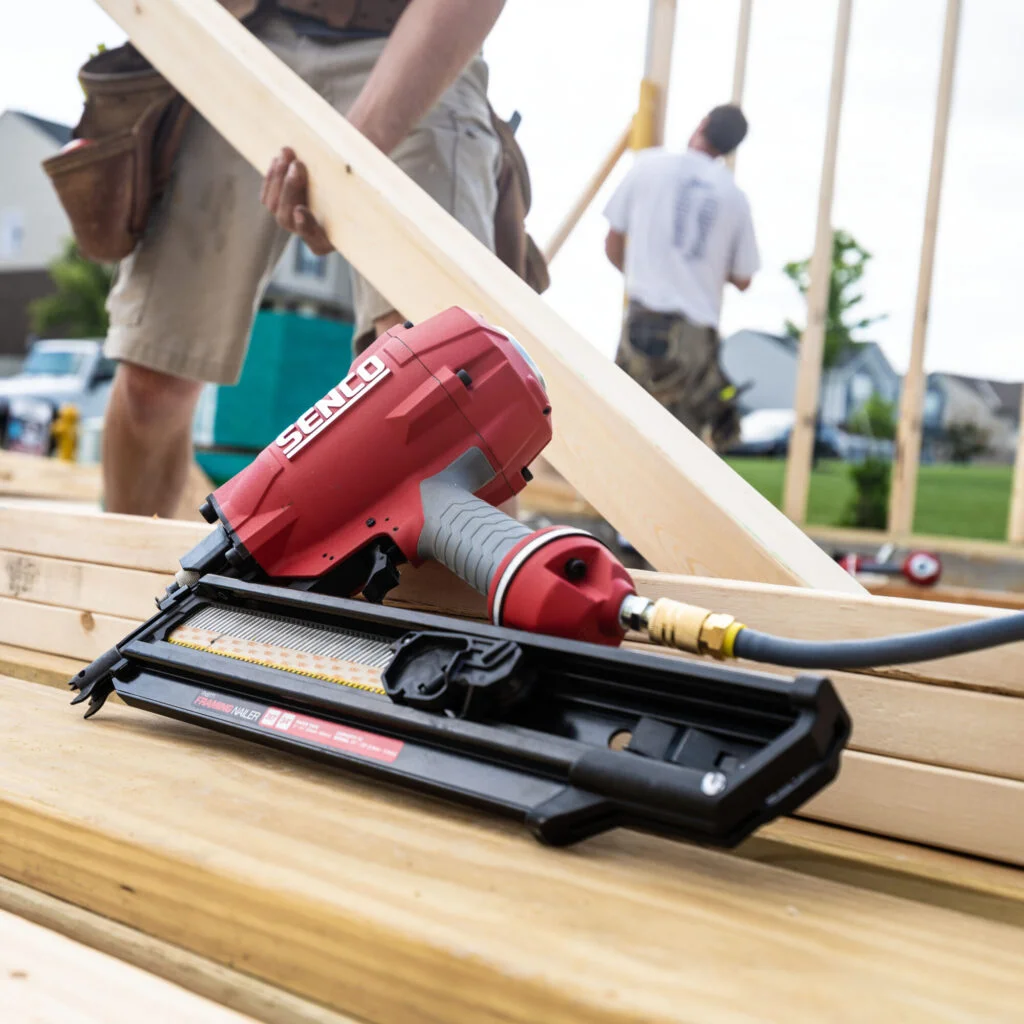
Framing nail guns are available in several different angles. The angle degree refers to the slant of the magazine, with framing nailers angled at 30 to 34 degrees providing the greatest access to tight spaces and corners in framing applications. (There are straight and less angled, 15-degree, 21-degree, and 28-degree framing nailer options as well.)
Although a specific date for the introduction of the 34-degree angled nailer is unknown, it is generally agreed that it hit the market – alongside straight nailers and some “straighter” angled versions – in the 1970s.
30-degree framing nailers are a somewhat special case. They were initially introduced by Paslode in the mid-1990s and specifically created to fire their RounDrive full round head nails. (more on this below) 30-degree framing nailers are now available from many brands.
SEE SENCO ANGLED FRAMING NAILERS
Nail Collation Type: Not an Issue
Both 30- and 34-degree framing nailers call for “stick nail collation.” This refers to nails that are held together with paper (or, occasionally, plastic) and come in a long, straight clip. Most 30- to 34- degree angled nailers will drive 2” to 3-1/4” or 3-1/2” paper-collated framing nails. The right length depends primarily on the application and the thickness of the materials being joined. Choose longer length nails for heavy-duty framing where maximum strength and durability are required. 2” nails are ideal for lighter framing applications and securing thinner materials such as sheathing to framing members.
Nail Head Design: What Really Matters
Paper-taped framing nails have been a jobsite staple since the 1970s, and many long-time users assume that nail designs have stayed relatively the same. They’re just nails, right?
But manufacturers such as SENCO have spent decades refining and innovating to improve nail performance – and greater compatibility among various nail guns. The objective has been to offer contractors and industrial users better results with more flexibility. Here is a brief rundown of the work done on nail head design which has made the 30 vs. 34 degree distinction almost meaningless – while improving performance and quality.
“D” or Clipped Head Design – Originally, 34-degree nails featured a “D” or clipped head design to allow for proper stacking in paper-taped strips. This was the standard in the industry for many years because it minimizes the space between nails on a collated strip, allowing more nails to fit on a strip, and enabling a steeper angle of collation.
RoundDrive Full Offset Head Design – In the mid-1990s, Paslode introduced the RoundDrive nail specifically for their new 30-degree angled nailer, although it was eventually adapted for their other pneumatic and cordless nailers. The patented full offset head provided excellent holding power when used with Paslode tools, but it posed compatibility challenges with other brands.
ProNail® and RoundStrip® Head Nails – SENCO responded in the late 1990s and early 2000s with these more robust designs that offered compatibility across a wide range of tools including both SENCO and other manufacturers’ 30- to 34-degree angled nailers, while enhancing performance.
ProHead® Offset Full Head Design – In 2013, SENCO introduced the ProHead, a breakthrough design that combined the best features of its predecessors with testing across major brands of paper-taped nailers to prove its compatibility with a wide range of 30- to 34-degree angled nailers. Because of its increased holding power and versatility, by late 2024, SENCO established the ProHead offset full head design as the standard for all of its paper-tape framing nails.
While some brands continue to claim that you can only use the brand’s specific nails with their framing nailers and only 30-degree nails in 30-degree angled nailers and 34-degree nails in 34-degree angled nailers, this is, typically speaking, for marketing purposes only.
Most 30- to 34-degree nail guns will run other brands of nails with no issue, assuming the size of the nail matches the tool’s required specifications. The key is finding a nail brand and head design that meets your need for strength, reliability and precision.
Related Posts